SOFF X · AIHujjatingizni AI yaratsinSovg'ani oling
Mahsulot tavsifi
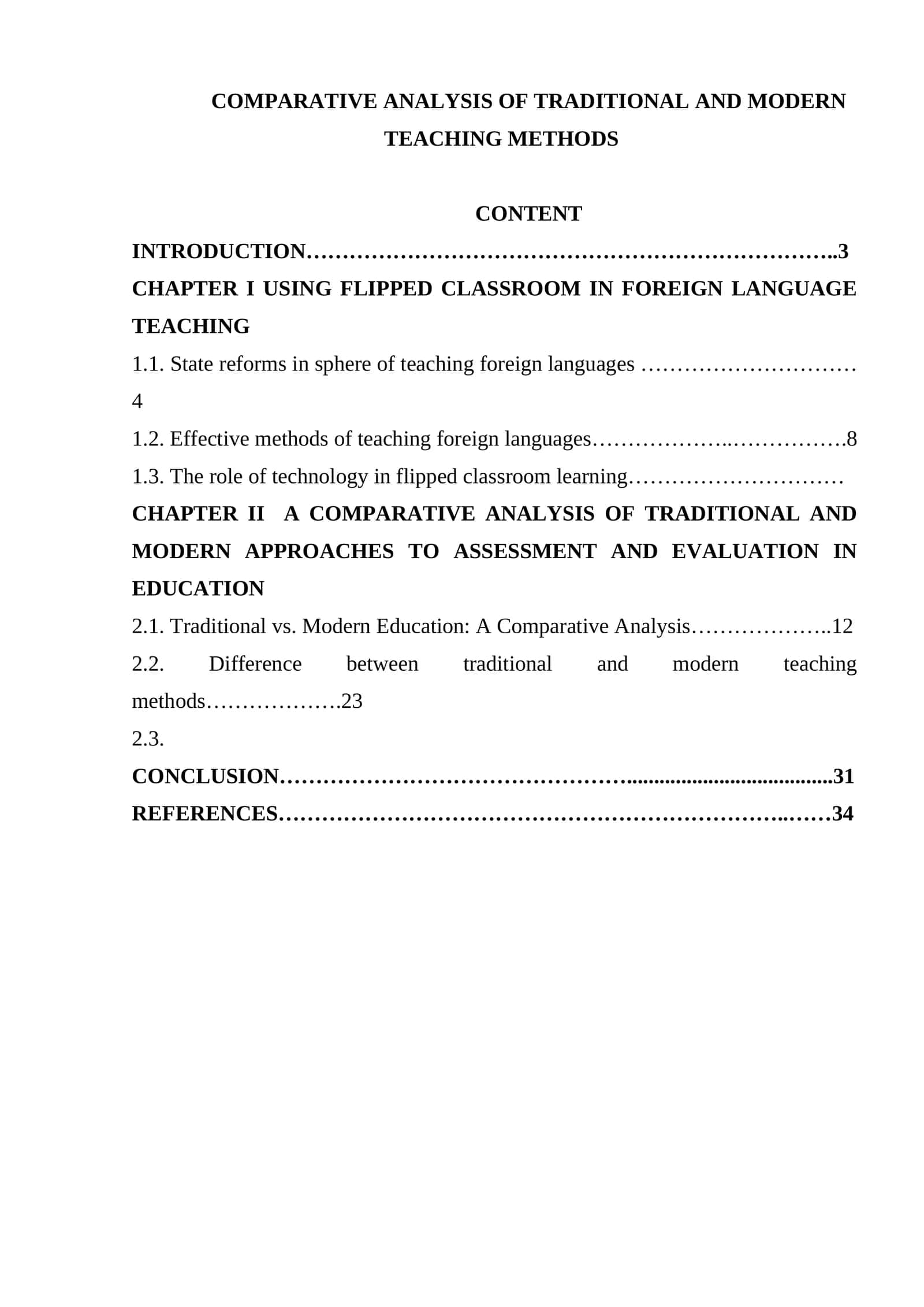
CONTENT INTRODUCTION ................................................................................................. 3 CHAPTER I. THE FUNDAMENTALS OF TRADITIONAL TEACHING ....6 1.1. Characteristics of the Teacher-Centered Approach...........................................6 1.2. Advantages and Limitations of Traditional Methods.......................................16 CHAPTER II.THE EVOLUTION OF MODERN TEACHING METHODS ..23 2.1. Student-Centered Learning and the Use of Technology…................................23 2.2. Challenges of Modern Methods and the New Role of Teachers......................29 CONCLUSION .....................................................................................................37 THE LIST OF USED LITERATURE ................................................................39 INTRODUCTION The actuality and importance of the theme . President Shavkat Mirziyoyev has frequently highlighted that the future of Uzbekistan depends on the intellectual potential of its youth and the fundamental reform of the education system. In his speeches, it has been stressed that modern schools must move away from old, ineffective models and instead adopt innovative pedagogical technologies. Current educational decrees are designed to transform the national curriculum by focusing on quality rather than quantity. By fostering a modern learning environment, the leadership aims to prepare a new generation capable of thinking creatively and competing on a global scale through advanced knowledge and logical reasoning [1] . In the context of language learning, comparing traditional and modern teaching methods is becoming a vital necessity. Learning English is no longer just about mastering grammar rules through the “Grammar-Translation” method; it is about using the language as a dynamic tool for communication. In a modern classroom, the ability to interact, collaborate, and use digital resources is just as important as reading a textbook. This shift in focus helps students move beyond basic memorization and prepares them for real-world academic and professional challenges where active language skills are required. The integration of modern, student-centered methods changes the entire dynamic of the classroom. Instead of being passive listeners who simply follow the teacher’s instructions, students become active participants in their own learning journey. They are encouraged to engage in discussions and group projects rather than just accepting information at face value. This approach is particularly effective because it makes the lessons more meaningful. When students are given the freedom to explore the language through modern techniques, they become more motivated, which naturally leads to a higher level of proficiency and confidence. Ultimately, the main goal of this research is to explore the differences between traditional and modern teaching methods in the EFL (English as a Foreign Language) environment. We will look at how moving from a teacher-centered approach to an interactive, technology-based model can turn a standard lesson into a platform for intellectual growth. By focusing on this comparison, the research aims to show how specific methods can help Uzbek students become more successful in their future careers. This introduction sets the stage for a deeper look into the theories and practices that are shaping the future of education in Uzbekistan. The relevance of this research lies in the urgent need to transition from traditional, teacher-centered structural models to modern, interactive approaches in the English language classroom. In today's globalized world, simply memorizing grammar rules and mechanical forms is no longer sufficient for effective communication. Contemporary students require practical skills that allow them to utilize English naturally in real-world professional and social settings. Furthermore, as Uzbekistan undergoes significant educational reforms under the leadership of President Shavkat Mirziyoyev, shifting toward modern, technology-based, and student-centered methodologies makes this topic highly relevant, appropriate, and timely. The purpose of the course paper. The primary aim of this coursework is to investigate the fundamental differences between traditional teaching styles and modern communicative methods, determining their specific impact on language acquisition within an EFL (English as a Foreign Language) learning environment. The object of the study. The object of this study is the overall process of teaching and learning English as a Foreign Language (EFL) within educational institutions, including standard curricula, instructional models, and classroom interaction patterns. The subject of the study . The subject of this research encompasses the specific comparative methodologies, pedagogical theories, lesson plan frameworks, and educational tools (such as traditional textbooks versus modern multimedia) used to implement both teacher-centered and student-centered instruction. The hypothesis of the course work . If traditional, teacher-centered structural models are systematically replaced with modern communicative methods and interactive technology, then EFL learners will develop higher communicative fluency, increased classroom motivation, and more adaptable real-world language skills compared to those taught through mechanical forms. The practical significance . The practical significance of this coursework lies in its ability to provide English educators with a clear, actionable comparison and a methodological “roadmap” for selecting the most effective teaching strategies. The study offers practical insights into how to seamlessly integrate modern technology and interactive tasks into daily lessons to boost student participation. Furthermore, its direct focus on realistic communication provides language learners with essential workplace skills, helping teachers build a flexible, efficient, and interactive environment that perfectly meets the demands of 21st-century learners. The structure of the coursework . The coursework consists of an introduction, Chapter I, Chapter II, a conclusion, and a list of used literature. [1] Mirziyoyev Sh.M. Yangi O‘zbekiston strategiyasi. – Toshkent: O‘zbekiston, 2021. – 464 B.
Muallif

- Hujjatlari
- 854
- Sotilgan
- 305