SOFF X · AIHujjatingizni AI yaratsinSovg'ani oling
Mahsulot tavsifi
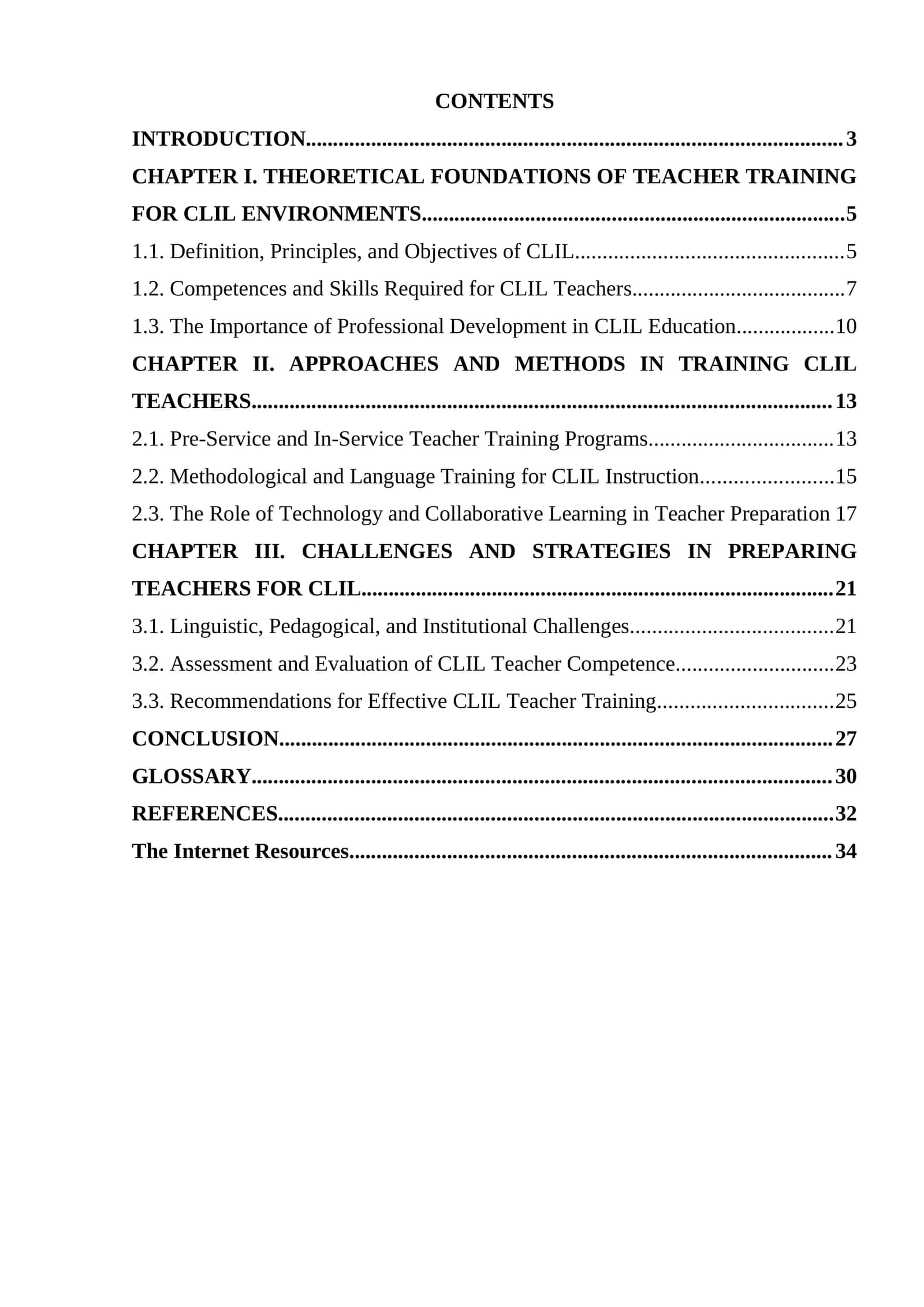
CONTENTS INTRODUCTION.. 3 CHAPTER I. THEORETICAL FOUNDATIONS OF TEACHER TRAINING FOR CLIL ENVIRONMENTS. 5 1.1. Definition, Principles, and Objectives of CLIL. 5 1.2. Competences and Skills Required for CLIL Teachers. 7 1.3. The Importance of Professional Development in CLIL Education. 10 CHAPTER II. APPROACHES AND METHODS IN TRAINING CLIL TEACHERS 13 2.1. Pre-Service and In-Service Teacher Training Programs 13 2.2. Methodological and Language Training for CLIL Instruction. 15 2.3. The Role of Technology and Collaborative Learning in Teacher Preparation. 17 CHAPTER III. CHALLENGES AND STRATEGIES IN PREPARING TEACHERS FOR CLIL.. 21 3.1. Linguistic, Pedagogical, and Institutional Challenges. 21 3.2. Assessment and Evaluation of CLIL Teacher Competence. 23 3.3. Recommendations for Effective CLIL Teacher Training. 25 CONCLUSION.. 27 GLOSSARY.. 30 REFERENCES. 32 The Internet Resources 34 INTRODUCTION The actuality and importance of the theme. In the era of globalization, the demand for qualified specialists in both professional fields and foreign languages is increasing. In accordance with the Decree of the President of the Republic of Uzbekistan dated May 19, 2021, No. PQ-5117 “On measures to raise the activities of popularizing the study of foreign languages in the Republic of Uzbekistan to a qualitatively new level”, the integration of foreign languages with academic subjects has become a strategic priority [1] . The Content and Language Integrated Learning (CLIL) approach, which involves teaching a subject (such as history, science, or mathematics) through a foreign language, is the most effective way to meet these national requirements. However, the successful implementation of CLIL directly depends on the qualifications of the teacher. Preparing teachers for CLIL environments is highly relevant today, since traditional teaching methods no longer meet the need for dual education, where content and language must be balanced and taught simultaneously. The purpose of the course paper. The aim is to analyze the key competencies required for CLIL teachers, identify the structural and linguistic difficulties in their teaching process, and develop effective strategies and recommendations for preparing teachers to work within a CLIL environment. The object of the study. The main object is the process of professional development and pedagogical training of teachers working in an environment of integrated language and content learning. The subject of the study. The subject of the study encompasses the theoretical and practical aspects of equipping teachers with the necessary linguistic, methodological, and cognitive competencies required for teaching academic subjects through a foreign language. The hypothesis of the course work. If professional training and in-service training programs for CLIL teachers focus on the simultaneous development of language scaffolding strategies and subject-specific discourse rather than treating methodology and language proficiency separately, then teachers will successfully reduce the cognitive load on students and achieve dual lesson objectives effectively. The structure of the course work. The structure of the course work consists of an introduction, three chapters (covering theoretical foundations, training approaches/methods, and strategic recommendations for overcoming institutional challenges), a conclusion, a glossary, and references. [1] Decision PQ-5117 dated May 19, 2021 of the President of the Republic of Uzbekistan “On measures to bring the activity of popularizing the study of foreign languages to a qualitatively new level in the Republic of Uzbekistan”
Muallif

- Hujjatlari
- 854
- Sotilgan
- 305